The Ä¢¹½ÊÓƵ is the host university for the 2020 American Association for the Advancement of Science Annual Meeting (). The conference is Feb. 13-16 at the Washington State Convention Center in Seattle.
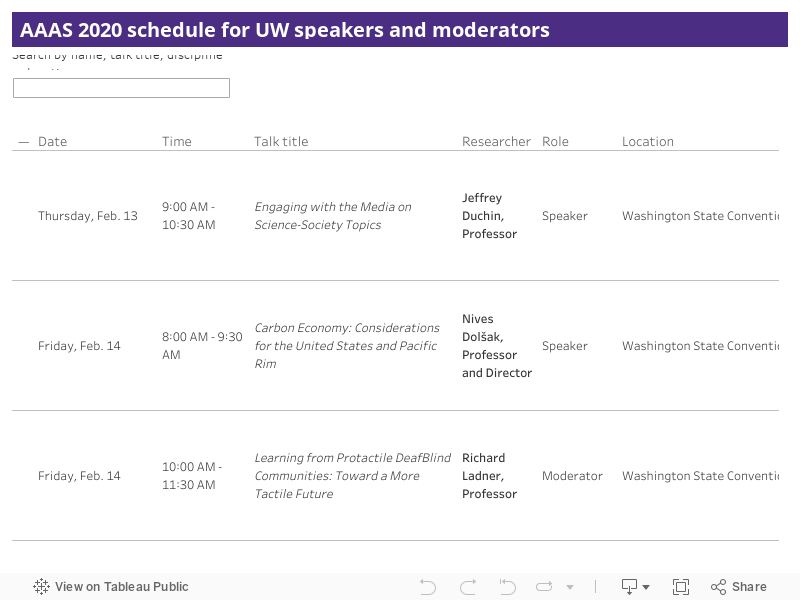
The Ä¢¹½ÊÓƵ has more than 50 speakers and session moderators participating in the conference across a number of topics, including earthquakes, climate change impacts, misinformation during emergencies, criminal justice reform, early childhood learning and using artificial intelligence to stop child sex trafficking.
Additionally, Ä¢¹½ÊÓƵ President Ana Mari Cauce will welcome conference attendees to Seattle at a kickoff reception Feb. 13. The Ä¢¹½ÊÓƵ and Burke Museum of Natural History and Culture will host a social event Feb. 15 at the museum for hundreds of journalists attending the conference.
- Story:ÌýÄ¢¹½ÊÓƵ is host university for 186th AAAS meeting in Seattle
- Blog:ÌýEmerging scientists at AAAS annual meeting are essential to the future – Provost Mark Richards
- Editorial: – The Seattle Times
- Story:ÌýResearchers at AAAS to discuss latest science on Cascadia earthquake hazards

Population Health Initiative
Learn about the Ä¢¹½ÊÓƵ’s 25-year, interdisciplinary effort to bring understanding and solutions to the biggest challenges facing communities.
Ä¢¹½ÊÓƵ booth (#219)
Stop by the Ä¢¹½ÊÓƵ booth at the AAAS Expo.
More than a dozen Ä¢¹½ÊÓƵ scholars presenting at the meeting will be available Friday through Sunday to talk with attendees. Dubs II will make a special appearance at the booth on Sunday morning. The Expo Hall is with free on-site registration, check out the for more info.

Lisa GraumlichÌý— Dean, College of the Environment
Lisa Graumlich is available to discuss opportunities to bridge science and practice to address the risks we face from climate change and other environmental challenges. She is also interested in how we support young scientists in developing leadership skills to be successful in transdisciplinary work.
At the Ä¢¹½ÊÓƵ booth: Friday, Feb. 14 from 3:30 to 4 p.m.

Alexes HarrisÌý— Professor, Sociology
Alexes Harris is a sociologist who uses a mixed-method approach to study institutional decision-making. Her research interests focus on social stratification processes and racial and ethnic disparities.
At the Ä¢¹½ÊÓƵ booth: Saturday, Feb. 15 from 9:45 to 10:15 a.m.

David BakerÌý— Professor and Director of the Institute for Protein Design
David Baker’s research group is focused on the prediction and design of macromolecular structures, interactions and functions. The group is currently working on a universal flu vaccine.
At the Ä¢¹½ÊÓƵ booth: Saturday, Feb. 15 from 12:00 p.m. to 12:30 p.m. (New time!)

Emma Spiro —ÌýAssistant Professor, Information School
Emma Spiro’s research involves the spread of information during crisis events, including rumors, misinformation and collective sensemaking in online environments.
At the Ä¢¹½ÊÓƵ booth: Saturday, Feb. 15 from 12:30 to 1:00 p.m.

Emily M. BenderÌý— Professor, Linguistics
Emily M. Bender’s research interests include ethics and natural language processing; fairness, transparency and accountability in natural language processing and AI more broadly; and multilingual natural language processing.
At the Ä¢¹½ÊÓƵ booth: Saturday, Feb. 15 from 1 p.m. to 1:30 p.m.Ìý(New time!)

Gina-Anne LevowÌý—ÌýAssociate Professor, Linguistics
Gina-Anne Levow’s research concentrates on the use of intonation in spoken dialog, and her interests range over natural language processing, spoken language systems and human-computer interfaces.
At the Ä¢¹½ÊÓƵ booth: Saturday, Feb. 15 from 1:00 to 1:30 p.m.Ìý(New time!)

Jeff BermanÌý— Associate Professor, Civil & Environmental Engineering
Jeff Berman’s research blends experimental and analytical investigations to help develop the tools and understanding necessary for engineers to design structures to resist the forces of earthquakes, blasts and other hazards.
At the Ä¢¹½ÊÓƵ booth: Saturday, Feb. 15 from 2:00 to 2:30 p.m.

Amy SnoverÌý— Director, Climate Impacts Group
Amy Snover connects science and decision making to help society prepare for the impacts of climate change. She leads innovative efforts to catalyze and enable science-based actions that reduce climate risks.
At the Ä¢¹½ÊÓƵ booth: Saturday, Feb. 15 from 3:15 to 3:45 p.m.

Patricia KuhlÌý— Professor and Co-Director, Institute for Learning & Brain Sciences
Patricia Kuhl is internationally recognized for her research on early language learning and bilingual brain development, for pioneering brain measures on young children, and for studies that show how young children learn.
At the Ä¢¹½ÊÓƵ booth: Saturday, Feb. 15 from 4 to 4:30 p.m.

Andrew MeltzoffÌý— Professor and Co-Director, Institute for Learning & Brain Sciences
Andrew Meltzoff’s discoveries about infant learning have revolutionized our understanding of early cognition, personality and brain development.
At the Ä¢¹½ÊÓƵ booth: Saturday, Feb. 15 from 4 to 4:30 p.m.

Dubs IIÌý— Ä¢¹½ÊÓƵ live mascot
Dubs II is 2 years old. He can run really fast, especially when properly motivated by cougar stuffies. He knows how to make an entrance and usually stops traffic when out on a walk.
At the Ä¢¹½ÊÓƵ booth: Sunday, Feb. 16 from 10:30 to 11:15 a.m.

Kristina OlsonÌý— Associate Professor, Psychology
Kristina Olson’s research focuses on gender diversity in childhood, prosocial behavior, understanding status and inequality, prejudice and discrimination.
At the Ä¢¹½ÊÓƵ booth: Sunday, Feb. 16 from 2:30 to 3 p.m.

Sally JewellÌý—ÌýChair, Ä¢¹½ÊÓƵ EarthLab Advisory Council
Sally Jewell, U.S. Secretary of the Interior under President Barack Obama and former CEO of REI, serves as Chair of Ä¢¹½ÊÓƵ EarthLab’s Advisory Council and is Interim CEO of The Nature Conservancy, a global environmental NGO.
At the Ä¢¹½ÊÓƵ booth: Sunday, Feb. 16 from 3:45 to 4:15 p.m.
Public event
Family Science Days are Saturday and Sunday, Feb. 15-16 from 11 a.m. to 4 p.m. both days.
Research highlights from Ä¢¹½ÊÓƵ speakers at AAAS

Sea-level rise report contains best projections yet for Washington’s coasts
A Ä¢¹½ÊÓƵ report provides the best projections yet for sea-level rise due to climate change at 171 sites along Washington’s coasts.

Biggest extinction in Earth’s history caused by global warming
New research shows that the Permian mass extinction in the oceans was caused by global warming that left animals unable to breathe.

Hydropower dams cool rivers in the Mekong River basin, satellites show
Using 30 years of satellite data, Ä¢¹½ÊÓƵ researchers discovered that within one year of the opening of a major dam in the Mekong River basin, downstream river temperatures during the dry season dropped by up to 3.6 degrees F (2 degrees C).


A tool resource center for natural disaster researchers
The RAPID Facility at the Ä¢¹½ÊÓƵ, which is the first of its kind in the world, contains over 300 instruments.
The achievement opens new approaches to the design of protein-based therapeutics for the treatment of cancer, autoimmune diseases and other disorders.

Forests, human health, Northwest outlook
Ä¢¹½ÊÓƵ researchers were among the authors of the Fourth National Climate Assessment, an assessment of climate change across the nation produced every four years by the federal government.

Ä¢¹½ÊÓƵ creates Center for an Informed Public with $5 million investment from Knight Foundation
The Ä¢¹½ÊÓƵ Center for an Informed Public is led by an interdisciplinary group whose mission is to resist strategic misinformation, promote an informed society and strengthen democratic discourse.

From counseling services to commissary items, how the private sector shapes ‘offender-funded justice’
Alexes Harris, Ä¢¹½ÊÓƵ professor of sociology, is leading a national study that has demonstrated the disproportionate impact of court-imposed fines and fees on the poor and on people of color.

Altruistic babies? Study shows infants are willing to give up food, help others
New research by the Ä¢¹½ÊÓƵ’s Institute for Learning & Brain Sciences finds that altruism may begin in infancy.



Interactive tool helps explore a century of Pacific Northwest weather data
The Ä¢¹½ÊÓƵ College of the Environment partnered with Seattle visual analytics company Tableau Software to create a new, interactive visualization for historical observations of temperature and precipitation in the region.

‘The blob,’ food supply squeeze to blame for largest seabird die-off
Scientists from the Ä¢¹½ÊÓƵ, the U.S. Geological Survey and others blame an unexpected squeeze on the ecosystem’s food supply, brought on by a severe and long-lasting marine heatwave known as “the blob.â€�

Young herring ‘go with the older fish’ a key finding in Ocean Modeling Forum
Similar to how children learn, often unconsciously, to mimic the adults around them, a small, silvery ocean fish employs this tactic when teaching the next generation.
Browse conference appearances by Ä¢¹½ÊÓƵ researchers